
Technique guide · 8 min read
How to cook with aluminium pots
Pure aluminium is the most heat-conductive metal in everyday cookware. That is its advantage — and the reason it sometimes confuses people. If you have used aluminium for years and never had a problem, this article will not change anything for you. If you are new to aluminium pots, or you have had food stick or burn, the issue is almost always one of three things: too much heat at the start, no preheat, or no oil. This is a practical guide to all three.
The five-second version
- Pure aluminium conducts heat very fast — what you set as "medium" on aluminium is hotter than "medium" on a thinner steel pot.
- For protein: preheat the empty pot 2 minutes on medium, add oil, wait 30 seconds, then add the food. Drop to medium-low after the food is in.
- For pap and stews: bring water to a boil on high, then drop to low. Pure aluminium spreads heat evenly across the base — burning happens when the heat is left too high after the food is in.
- Dark grey film on the inside? That is aluminium oxide. Normal. Food-safe. Cleans with cream of tartar or lemon.
- Metal handles get hot — by design, because they carry the weight of a full catering pot. Always use a dry cloth or mitts.
The physics, briefly
Why pure aluminium is different from steel
Aluminium conducts heat dramatically faster than the alternatives. By thermal conductivity (a measurable physical property), aluminium is roughly fifteen times more conductive than stainless steel, and about five times more conductive than cast iron. In practice that means the base of an aluminium pot reaches cooking temperature in about a minute on medium, whereas a comparable stainless or cast-iron pot of the same wall thickness needs several minutes to come up to the same temperature. (Exact times depend on wall thickness, hob power, and pot weight.) That is the trade-off you get: faster, more even heat — but a pot that responds more aggressively to whatever heat you set.
This is why aluminium is the standard for high-volume catering across South Africa, churches, community kitchens, and traditional cooking — even heat means the pap or stew at the bottom of a 50-litre pot cooks at the same rate as the food at the top. But it also means that if you cook on aluminium the same way you cooked on a thinner steel pot at home, you will hit a higher real temperature than you expected. The solution is not a different pot. The solution is one notch lower on the dial.
The technique that prevents 90% of sticking
The five-step method for protein
This is the same technique restaurant kitchens use on aluminium and on stainless. It takes 30 seconds to learn and removes almost all "food stuck to the pot" problems.
- Preheat the empty pot on medium for 2 minutes. Do not put oil in yet. Do not put food in yet. Just heat the empty pot. The aluminium needs to come up to a stable temperature so it does not steal heat from the oil and the food when you add them. Skip this step and chicken sticks.
- Drop a few water droplets on the pot. If they bounce, it is ready. Tap a fingertip of water onto the centre of the pot. Beads of water that skitter across the surface (the Leidenfrost effect) mean the pot is at frying temperature, around 160–180 °C. Water that just sits and hisses means the pot is still too cool.
- Add a thin layer of oil and wait 30 seconds. A tablespoon for a 30 cm pot. Sunflower, canola, peanut, or any neutral oil with a high smoke point. The oil should shimmer slightly — that is your visual cue. If it smokes, the pot is too hot; take it off the heat for 30 seconds.
- Add the food in one layer. Do not crowd the pot. If you can hear it sizzle as it goes in, the temperature is right. If it goes in silent, the pot was too cool. If it spits violently, the pot was too hot. Leave the food alone for 90 seconds — protein releases from the pot once it has formed a sear. If you try to move it earlier, it sticks. That is not the pot's fault.
- Drop the heat to medium-low for the rest of the cook. Aluminium retains heat well; you do not need the same setting all the way through. This single step prevents almost all the "burnt at the bottom" problems.
Reference table
Heat level by food type on aluminium
This is a rough guide for pure aluminium pots specifically. Settings on the dial are approximate — every stove is different.
| Food | Heat at start | Heat once food is in | Notes |
|---|---|---|---|
| Pap (mealie meal) | High to boil | Low | Bring salted water to a rolling boil, drop to low, stir in mealie meal slowly, cover, cook 30–40 min, stir every 10 min. |
| Stew or soup (large batch) | Medium-high to sear | Low to simmer | Sear protein first on medium-high, then add liquid and drop to low for the long simmer. Cover the pot. |
| Chicken pieces, chops, mince | Medium (preheat 2 min) | Medium-low | Use the five-step method above. Do not move the food for 90 seconds after it goes in. |
| Vegetables (boiled, blanched) | High to boil | Medium-low | Aluminium boils water fast — keep the lid on while heating to save energy. |
| Eggs (scrambled, fried) | Low (preheat 3 min) | Low | Eggs are the trickiest food on any pot. Preheat longer, use a small amount of butter or oil, keep the heat low throughout. |
| Rice (boiled) | High to boil | Lowest possible | Aluminium retains heat — once the rice is at a simmer, reduce to the absolute lowest setting and cover. |
| Acidic dishes (tomato bredie, curry, chutney) | Medium | Low | For very long simmers (4+ hours), consider stainless or enamel. |
The grey mark
The dark grey film: what it is and how to clean it
If you cook tomato-based dishes, lemon sauces, or simply boil tap water in an aluminium pot for a long time, you may see a thin grey or black film on the inside. This is aluminium oxide — a layer of oxidised metal that forms when aluminium reacts with water, acid, or alkali. It is food-safe and harmless. It is not burnt food. It is the pot's surface chemistry.
To remove it
- Fill the pot with water to cover the marks.
- Add 1 tablespoon of cream of tartar OR the juice of one lemon OR 2 tablespoons of white vinegar.
- Bring to a simmer for 10 minutes.
- Pour out and wash with mild dish soap. Do not use steel wool.
The film will come off and the pot will be bright again. The mark may return after the next acidic dish. That is normal and does not affect performance or safety.
A disclosed feature, not a defect
Why the metal handles get hot — and the right way to lift
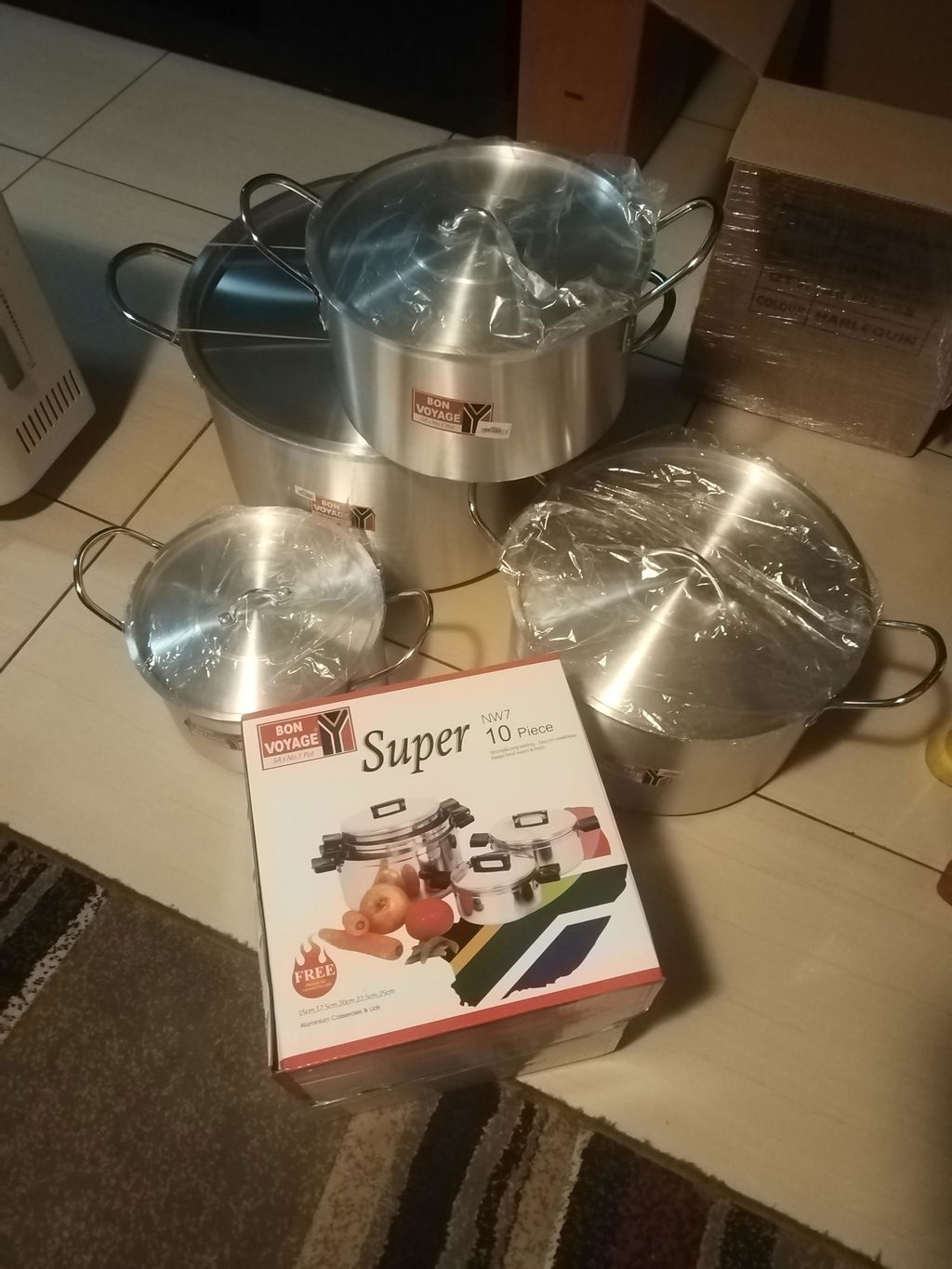
Bon Voyage Extra Heavy Duty catering pots, and most professional South African aluminium catering cookware, use solid metal ring handles riveted into the pot wall. We choose this design because a full 70-litre pot of stew weighs over 70 kilograms, and plastic or screwed-on handles cannot carry that weight safely over years of catering use.
The trade-off is that metal handles conduct heat. Every Bon Voyage product page carries this warning: "All metal lids and handles will become hot during stovetop as well as oven use. Please use a dry thick cloth or oven mitts for lifting at all times."
- A dry cloth insulates. A wet cloth conducts heat directly to your hand — exactly the opposite of what you want.
- Oven mitts beat folded tea towels for very hot pots.
- If you cook the same large pot every week, keep two dedicated dry cloths near the stove. Restaurant kitchens do this.
A verified-buyer voice
From someone who has cooked with them
The single most upvoted customer review on the Bon Voyage Catering Pot Set Heavy Duty page on Takealot — with 286 helpful votes from other buyers as of 2026-05-16 — speaks to exactly this point:
wow… the quality is far more better than my expectation, stronger than harts pots nowdays. not burning food. btw, i love the strong handles and lids.
— Olebogeng, 5-star verified-buyer review, 19 September 2022 (reviewed 5 days after purchase). 286 helpful votes.
Source: takealot.com/bon-voyage-catering-pot-set-heavy-duty/PLID91261775, captured 2026-05-16.
"Not burning food" is technique meeting equipment. With the five-step method above, you will get the same result.
FAQ
Frequently asked questions
Why does food sometimes burn or stick on aluminium pots?
Pure aluminium conducts heat very quickly and very evenly. That is the strength of the material — but it also means an aluminium pot reaches high temperatures faster than a thinner steel pot at the same stove setting. If you place protein into a cold aluminium pot or a pot heated on a high setting, the food touches the metal surface before its own moisture can release. The fix is technique, not material: preheat the pot on medium for two minutes, add a thin layer of oil, wait for the oil to shimmer, then add the food. Once the food is in, drop the heat to medium-low.
What heat setting should I use for pap on an aluminium pot?
Bring water to a rolling boil on high, add salt, then reduce to medium-low and stir in the mealie meal slowly. Cover and cook on low for 30–40 minutes, stirring every 10 minutes. Pure aluminium distributes heat evenly across the base, so as long as the heat is low enough, the pap will not burn at the bottom.
What is the dark grey film that appears on aluminium pots?
That is aluminium oxide — a normal, food-safe surface layer that forms when aluminium reacts with water, acids, or alkaline foods. It does not affect cooking performance or safety. To remove it, simmer water with a tablespoon of cream of tartar or a sliced lemon for 10 minutes, then wash with mild soap. Avoid steel wool.
Why do the metal handles get so hot?
Bon Voyage catering pots use solid metal ring handles riveted into the pot wall — chosen for strength under load. A full 70-litre pot of stew weighs over 70 kilograms, and plastic or screwed-on handles cannot carry that weight safely. The trade-off is that handles conduct heat. Always use a dry, thick cloth or oven mitts.
Can I use aluminium pots on induction hobs?
Aluminium pots work on gas and electric stoves. They do NOT work on induction hobs unless the pot has a stainless steel or magnetic disc bonded to the base — pure aluminium is non-magnetic.
Is aluminium cookware safe for daily cooking?
Food-grade aluminium has been used for cooking globally for over a century. The European Food Safety Authority (EFSA) has set a Tolerable Weekly Intake for aluminium of 1 mg per kilogram of body weight, and concluded that the aluminium contribution from cookware is small relative to total dietary intake. For everyday pap, stews, soups, vegetables, and large-batch cooking, aluminium is well within established safety limits.
Related
Companion guides and the range
If you came here because you were comparing brands, the side-by-side companion is Bon Voyage vs Hart Pots — an honest comparison. The complete individual-pot range from 8 litres to 100 litres is at Bon Voyage Extra Heavy Duty Catering Pot.
Made for South African kitchens since 1977
Bon Voyage Extra Heavy Duty Catering Pots are manufactured at the Big5 Cookware factory in Thaba Nchu, Free State. 99.9% pure aluminium, 2.2–4mm wall thickness, nine sizes from 8 litres to 100 litres.
View the range →