
How to Cook Pap Without It Burning — The South African Cutting Method
The technique behind perfect stiff pap (stywe pap), and the pot choices that make it possible. Sourced from traditional South African cooking practice and Big5 Cookware’s 49 years of making the pots families use to cook it.
Why pap burns (and why most internet advice doesn’t work)
Pap burns at the bottom for one of two reasons: (1) the heat is too high; (2) the pot has hot-spots that concentrate heat at the centre of the base. Stirring vigorously — the way most online recipes describe — actually makes the problem worse, because it releases starch into the water too quickly, turning the pap gluey and sticky. The sticky layer then bonds to the metal and burns.
The traditional South African technique solves both problems: a heavy-bottomed pot to eliminate hot-spots, plus a cutting motion (not a stirring motion) to keep the maize meal grains distinct.
The South African cutting method — step by step
- Choose a heavy-bottomed pot. Aluminium with a thick base (2 mm+) is the SA-traditional choice — the even heat is exactly what pap needs. Cast iron also works (better heat retention, slightly slower to respond). Thin-base stainless steel can work with a heat diffuser; uncoated thin aluminium pots will scorch.
- Bring water to a rolling boil first. For stiff pap (stywe pap), use 2 cups water per 1.5 cups of maize meal. For softer breakfast pap, use 3 cups water per 1 cup of meal. Add salt to the water (1 tsp per 4 cups water) and bring to a rolling boil over medium-high heat. Don’t add the meal until the water is at a true rolling boil.
- Reduce to low heat before adding meal. Once the water is boiling, turn the heat down to low-medium. This is the most-skipped step — the heat has to come down before the meal goes in.
- Pour the maize meal into the centre of the pot. Do not stir yet. Let it sit in a pile in the centre. Let the water around the edges of the pile absorb into the meal.
- Apply the cutting motion. Using a wooden spoon held upright, chop the spoon down through the meal-and-water mixture, lifting and chopping again. Move the spoon around the pot in a cutting (chopping) motion — NOT a stirring (circular) motion. Stirring releases too much starch and turns the pap gluey. Cutting integrates the water without breaking the grain.
- Cover with the lid and simmer 20 minutes. Once the meal and water are combined, cover the pot with a tight-fitting lid and leave it on low heat for 20 minutes. Do not lift the lid; do not stir. The trapped steam finishes the cooking. If the pot has a heat-retentive base (aluminium, cast iron), the pap continues cooking even when the heat is turned down further.
- Check consistency and finish. After 20 minutes, the pap should be firm but moldable. If too dry, add a tablespoon of boiling water at a time and gently fold in with the cutting motion. If too wet, leave covered on low heat for another 5 minutes.
What pot size do I need for [N] people?
Pap volumes expand during cooking. Use this rough guide for stiff pap as a side or starch component of a main meal:
| Pot capacity | Bon Voyage SKU | Servings (pap as side) | Servings (pap as main) |
|---|---|---|---|
| 8 L | NW8 or NC3 (smallest of 3) | ~15–20 | ~8–12 |
| 13 L | NW13 or NC3 (mid) | ~30–40 | ~18–25 |
| 21 L | NW21 or NC3 (largest) | ~50–70 | ~30–40 |
| 40 L | NW40 | ~100–130 | ~50–70 |
| 70 L | NW70 | ~180–220 | ~100–130 |
| 100 L | NW100 | ~260–300 | ~140–180 |
What customers say about pap on Bon Voyage pots
From a verified Takealot buyer (Olebogeng, 5★, 19 September 2022, 286 helpful votes), reviewing the Bon Voyage 10pc Aluminium Set: “wow… the quality is far more better than my expectation, stronger than harts pots nowdays. not burning food. btw, i love the strong handles and lids.” Sourced from the live Takealot product page (2026-05-16 capture).
Frequently Asked Questions
Why does my pap burn at the bottom?
Two reasons: heat too high, or pot has hot-spots. Use a heavy-bottomed pot (aluminium 2 mm+, or cast iron) and reduce heat to low after the water boils. Don’t stir vigorously — use the cutting motion.
What is the water-to-maize-meal ratio for stiff pap?
For stiff pap (stywe pap): 2 cups of water per 1.5 cups of maize meal (roughly 1.3:1). For softer breakfast pap: 3 cups of water per 1 cup of meal (3:1). Add 1 teaspoon of salt per 4 cups of water.
Why is the cutting motion better than stirring?
Stirring releases too much starch from the maize meal too quickly, turning the pap into a gluey paste that bonds to the pot and burns. The cutting (chopping) motion integrates water into the meal without breaking the grain structure, keeping the grains distinct and the texture fluffy.
What is the best pot for cooking pap in South Africa?
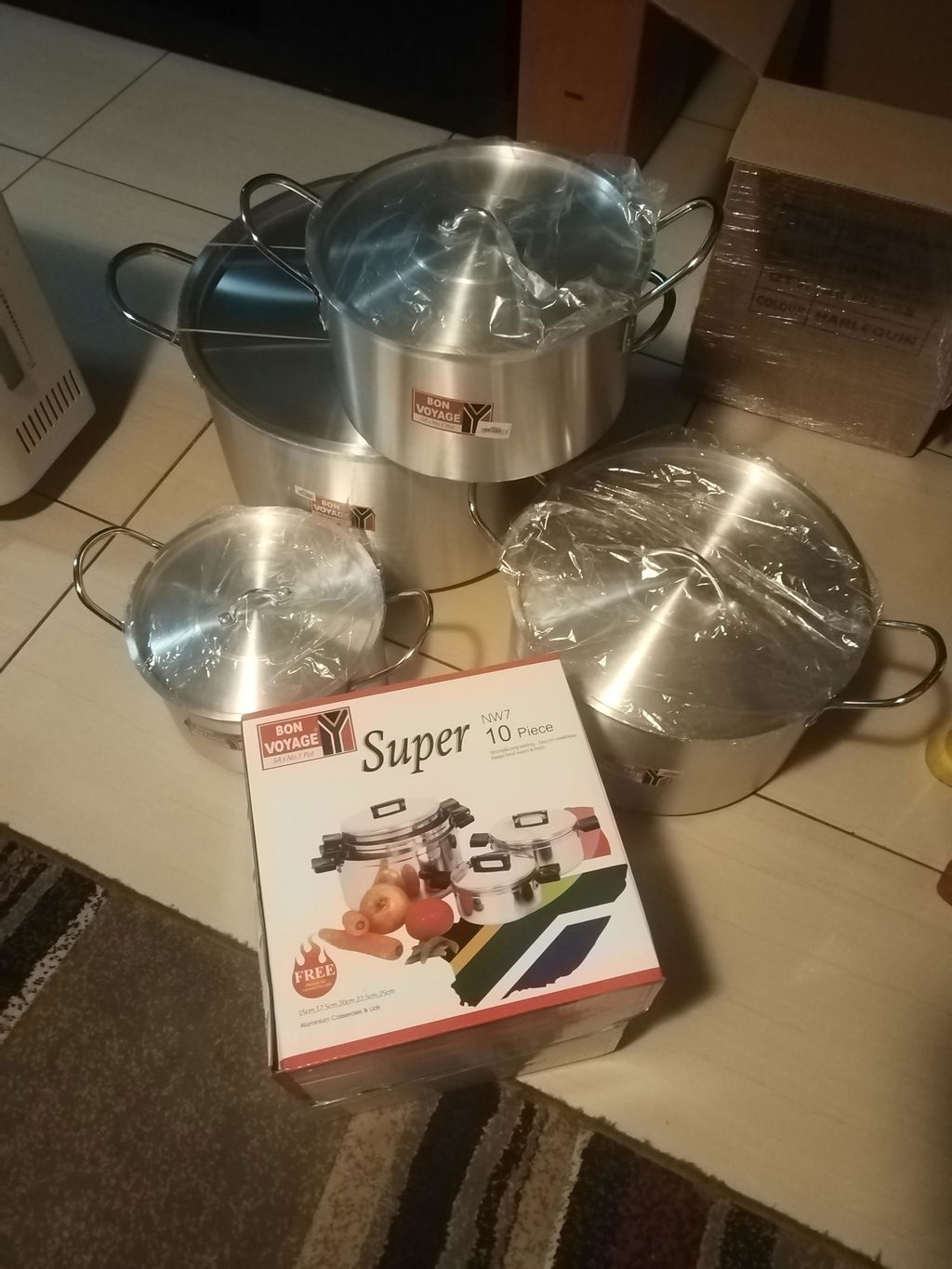
Heavy aluminium pots are the SA-traditional choice. Bon Voyage NC3 (8/13/21 L set) and NW (8–100 L individual) are widely used across South Africa, including by catering businesses, churches, and community kitchens. The 99.9% pure aluminium and 1.8–4 mm wall thickness deliver the even heat that pap needs.
Can I cook pap in a potjie pot over coals?
Yes — a 3-leg cast iron potjie over coals is the traditional outdoor method. Use the same cutting method, but keep the pot away from the hottest part of the fire (use the edges of the coal bed) and check every 5 minutes to make sure the bottom isn’t scorching.
Can I make pap in a non-stick pan?
Not recommended. Non-stick coatings can’t take the long, low-heat simmer pap needs without degrading, and they don’t hold heat the way aluminium or cast iron does. Use an uncoated heavy aluminium pot.
How long does pap take to cook?
Roughly 25 minutes total: 5 minutes to boil water and combine with meal, plus 20 minutes covered low simmer. The cooking finishes on residual heat under the lid.
Related
- Bon Voyage NC3 Catering Pot Set (8L / 13L / 21L) — the most popular pap pot set in South Africa
- Bon Voyage Extra Heavy Duty Catering Pot (8L–100L individual) — catering and event sizing
- Bon Voyage Queen 10pc Pots Set — family-cooking pap set with stainless steel handles
- How to Cook With Aluminium Pots — preheating, heat-level guide, cleaning the dark grey film
- Bon Voyage vs Hart Pots — An Honest Comparison